
Two separate issues are being confused.
Here's what Meta has already been doing, what it proposed to change, and what you can realistically do about either.
Last updated: 29 October 2026. This is a developing story, and I will update this post if Meta announces anything new.
If you've been told you need to object to Meta's AI training before 30 October or lose your content for good, take a breath. Most of the advice doing the rounds this month mixes up two separate things, and the urgency is pointing at the wrong one.
The short version
Meta has been using public content from UK adults' Instagram and Facebook accounts to train its AI since announcing the plan in September 2024. 30 October was never a deadline to object to that, and you can object to future use at any time.
The October controversy was about something else: proposed changes to Meta's terms for businesses, including permission to automatically access websites linked to business accounts. Those changes have been put on hold, and the existing terms still apply.
Contents
Is Meta already using Instagram posts to train AI?
How to object to Meta using your content for AI
What changed in Meta's business terms?
Why this matters if you publish original content
Has Meta delayed the new terms?
What should you actually do?
Is Meta already using Instagram posts to train AI?
Yes. On 13 September 2024, Meta announced it would begin training its AI on public content shared by adults on Facebook and Instagram in the UK. That covers public posts, photos, captions and comments, but not private messages or accounts belonging to under-18s.
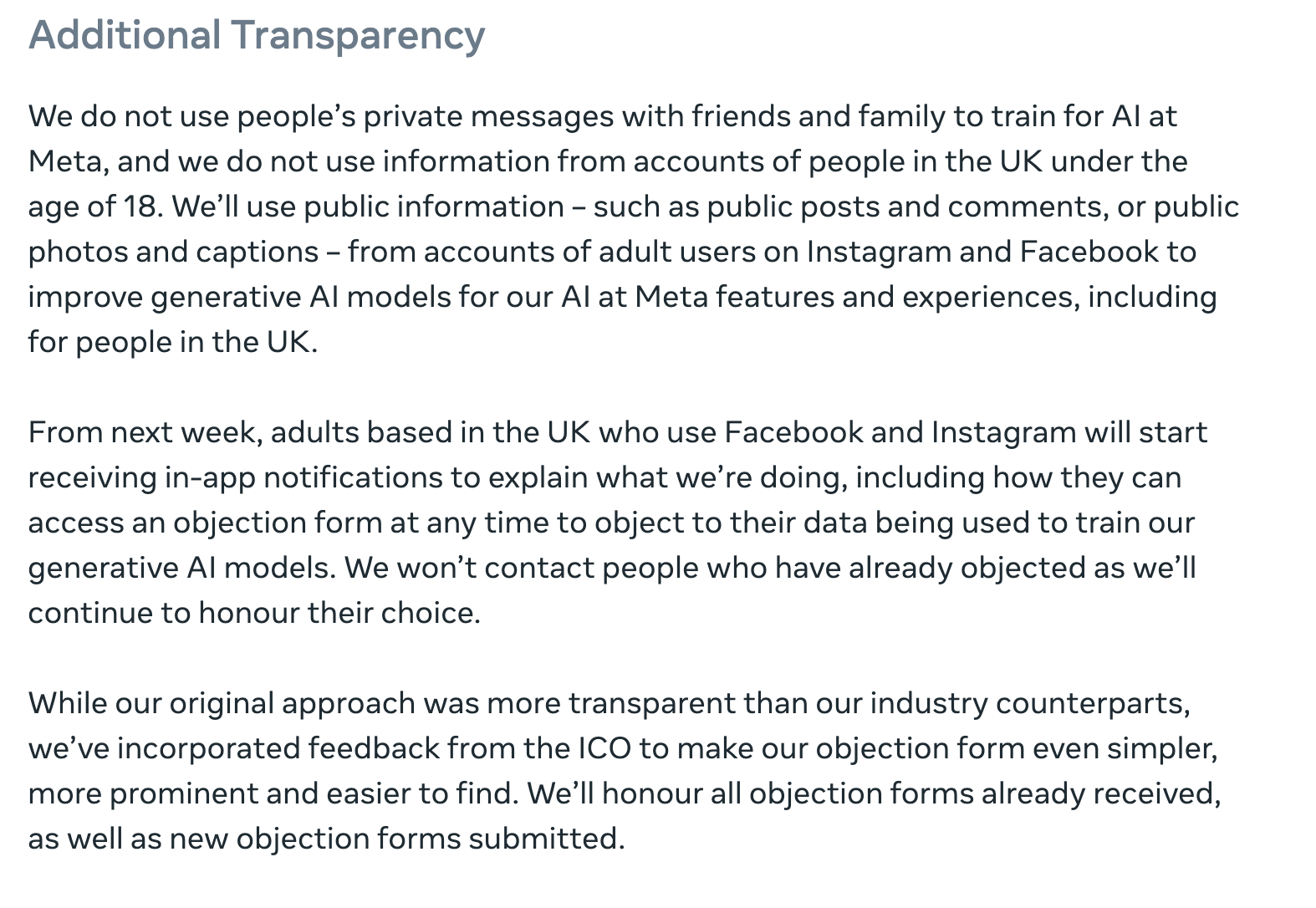
Meta's September 2024 announcement outlining its plans to use public Facebook and Instagram content for AI training in the UK.That was the announcement date, not necessarily the day training started, and Meta hasn't published a precise UK start date. The Information Commissioner's Office said at the time that it would monitor things, and that it had not given the plan regulatory approval. Either way, this has been running in the background for over a year. It doesn't switch on at the end of October 2026.
How to object to Meta using your content for AI
Meta relies on what UK data protection law calls 'legitimate interests', a legal basis that lets a company use information without asking first, provided it gives you the right to object. In the Instagram app, the route at the time of writing is Settings → Privacy Centre → AI at Meta → Object.
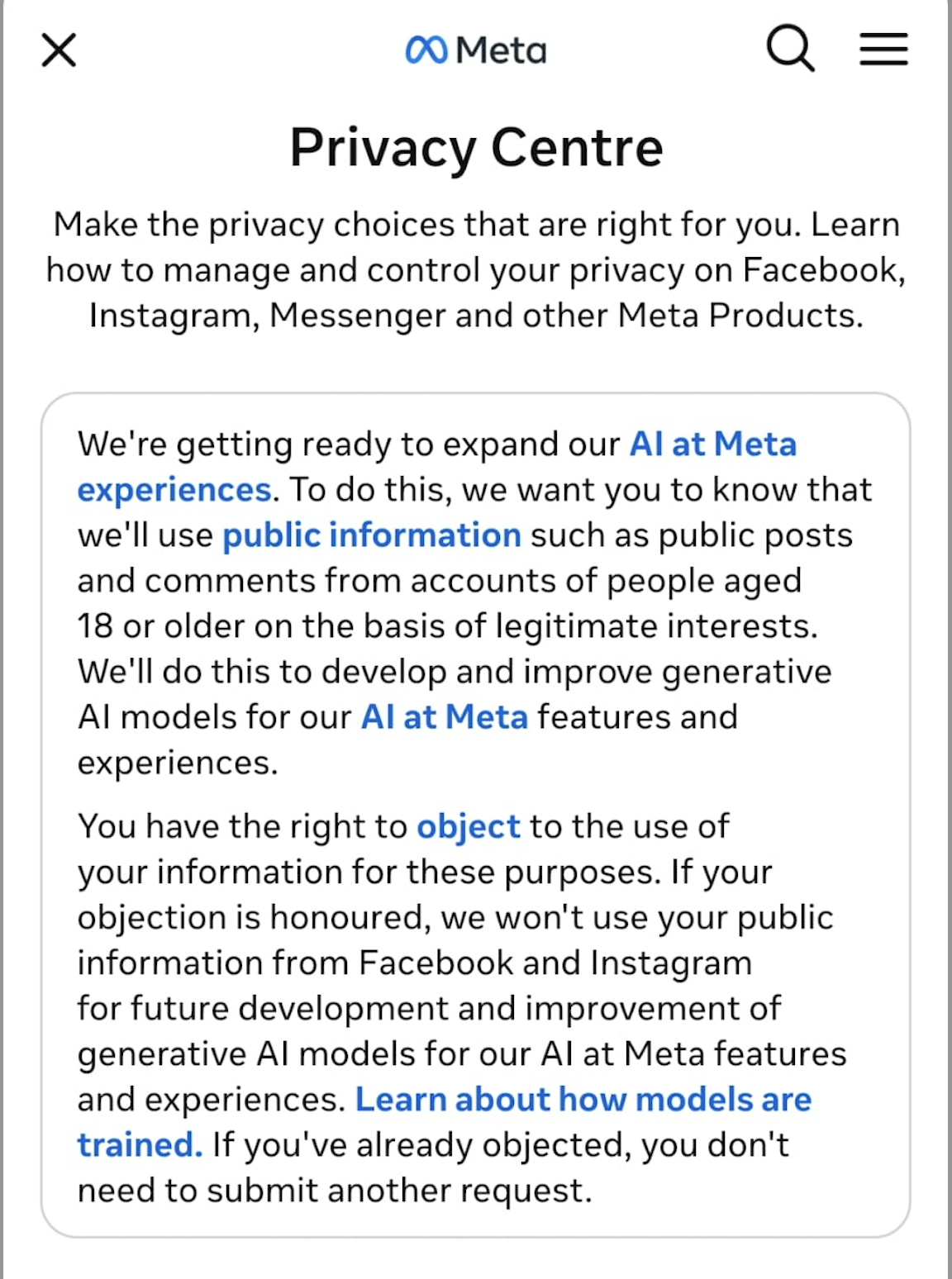
Meta's Privacy Centre notice about AI training and your right to object. This covers future AI training on your public Instagram and Facebook content, not Meta's proposed business terms.Meta says it will honour valid objections for future training. It doesn't say it will undo training that has already happened, so assume it won't. Objecting turns off the tap. It doesn't empty the bath. If you objected back in 2024, Meta says you don't need to do it again.
Part of the panic comes from the notice itself, which says Meta is 'getting ready to expand' its AI experiences. Next to posts warning of a deadline, that sounds brand new. But what it describes is the same arrangement Meta announced in 2024, and it doesn't mention 30 October at all.
What changed in Meta's business terms?
This is the genuinely new part. In October, Meta published proposed updates to its Commercial Terms, the rules for businesses using its products. They aren't only for people running ads. A practitioner with a business account is covered even if she's never boosted a post.
The controversial clause gave Meta permission to use crawlers on websites associated with a business. A crawler is a program that visits web pages automatically and reads what's on them. Meta already runs its own, so this isn't about crawling starting for the first time. It's about what businesses would be agreeing to, and what Meta could do with what it collects.
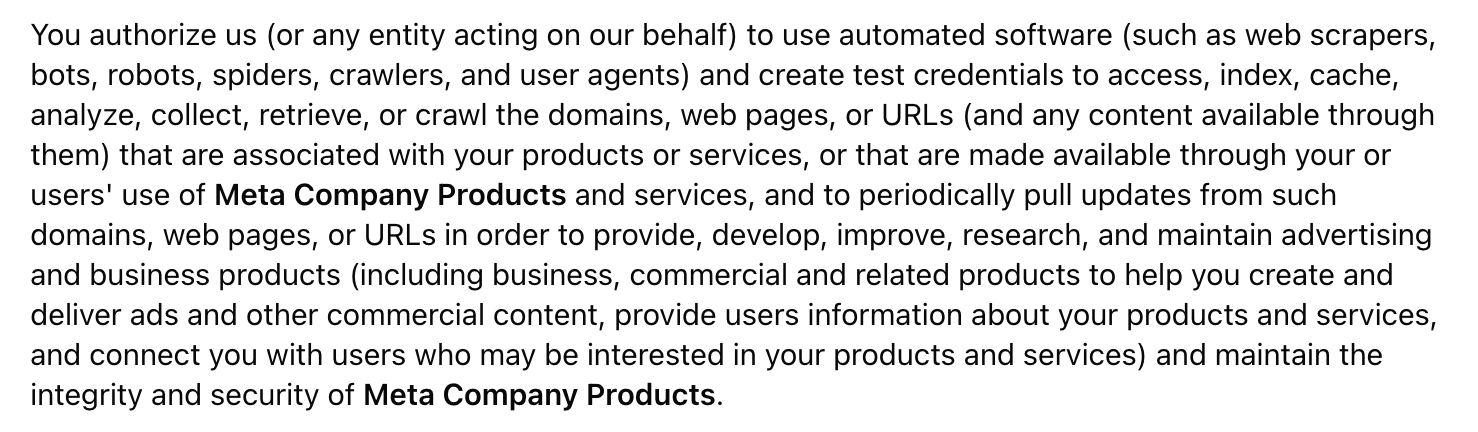
Extract from Meta's proposed Commercial Terms on automated access to websites associated with businesses. This is the revised wording from mid-October 2026, and these terms have not come into effect.That's the revised wording. When Nieman Lab first reported the terms on 15 October, the clause said Meta could use collected content to train its products. After criticism from publishers, Meta removed the word 'train' two days later and told The Verge the clause only ever applied to its ads and business products.
Legal experts quoted by Search Engine Journal weren't convinced, arguing that 'develop' could still be read to include training. So, to be clear: Meta has not said it will train AI on business websites, and it disputes claims that the terms allow it. Critics think the wording leaves the door open. Both are true at once.
Why this matters if you publish original content
Picture a nutritional therapist whose Instagram links to a Squarespace website holding years of researched articles on fertility, gut health and hormones. None of what follows is a confirmed consequence of Meta's terms. These are wider questions about AI and online information, but they're worth asking.
If an AI tool answers someone's question using her work, there's no guarantee it credits her. If the answer appears inside the app, fewer people click through to her website, which is where they'd find out who she is and book. And health information loses things in summary. A careful article about supplements in perimenopause, caveats and all, can come out as a confident one-liner with the caveats missing.
Original, well-researched content is what sets a practitioner apart from the generic wellness advice filling everyone's feed. Wanting a say in how it's used isn't paranoia.
Has Meta delayed the new terms?
Yes, twice. The terms were due to take effect on 30 October, which is where the date in all those warnings came from. After publishers and advertisers complained to the Competition and Markets Authority and the European Commission, Meta moved the date to 20 November.

Meta’s statement to Reuters on 23 October 2026, moving the start date to 20 November. On 28 October Meta put the terms on hold pending consultation.Then on 28 October, Reuters reported that Meta was delaying the rollout indefinitely. Meta's own statement said it wouldn't make changes without a full consultation with industry groups, that this could run past 20 November, and that until then its existing terms remain in place.
So as of 29th October, the new terms haven't taken effect, there's no new date, and they haven't been withdrawn either. Meta is consulting, not scrapping.
What should you actually do?
Treat these as two separate jobs. For your Instagram and Facebook content, object through the Privacy Centre if you don't want your public posts used for future AI training. It takes two minutes, and if you've already done it, you're done. It won't undo past training, and it has nothing to do with the business terms.
For your website, there's no objection form, and the terms aren't in force. What you can check is your robots.txt, a short public file that tells crawlers which parts of your site they're welcome to visit. Type your web address followed by /robots.txt to see yours.
Squarespace doesn't let you edit that file directly, but under Settings → Crawlers you can choose to block known artificial intelligence crawlers. If you do, check your robots.txt afterwards for meta-externalagent, the Meta crawler its own documentation says is used for purposes such as training AI.
Just don't treat it as a padlock. robots.txt is a request, not a legal right, and Meta's crawler documentation says some of its crawlers may bypass it in certain situations. It also can't remove anything already collected. And blocking AI crawlers is a trade-off: Meta says allowing its separate AI search crawler helps it cite and link to your content. Decide which matters more to your practice.
What you don't need to do is quit Instagram or delete your blog. Keep an eye out for a revised version of the terms, and read it when it appears.
WHAT TO TAKE AWAY
Meta's AI training on public social media content isn't new, and you can object to future use whenever you like. The October row was about a separate proposal for business websites, now on hold. One has an objection form. The other has crawler settings and a lot of unanswered questions.

If this has got you thinking about how people find your website in the first place, my free 5 Google Search Secrets is a good place to start.
My free 5 Google Search Secrets guide shows you the simple changes that help people searching for your expertise find you.

I’m Sam. I’ve spent the best part of a decade doing marketing for everyone from a fashion house to a TV presenter, and somewhere along the way I realised the people I most wanted to help were nutritional therapists and functional medicine practitioners. That was five years ago, and I’ve barely worked with anyone else since. I look after the whole of a practice’s online marketing, from the website and SEO to social media and everything that ties them together, for practitioners who are brilliant at what they do and tired of being the best-kept secret. I don’t do strategy decks that sit in a drawer. I do marketing that actually gets done.
Oh, and when the Trial Reels system I developed got my clients millions of views and thousands of new followers, I turned it into an Instagram course called Found & Followed. Register your interest here.