
Why Getting Found on Google Also Gets You Found on AI Search
Something shifted in how people search for health information, and it happened faster than most of us expected. Your potential clients are no longer just typing queries into Google. They're asking ChatGPT.
They're using Perplexity to research their symptoms. They're asking Gemini questions about which type of practitioner they should see.
For a lot of wellness practitioners, this raises an uncomfortable question: Does all the SEO work I've been doing still matter, or is there now a whole new set of rules to learn?
Here's the answer, and it's the most reassuring thing you'll read today. The foundations are the same. If you've been building your Google visibility through strong content, clear credentials, and a well-structured Squarespace website, you have already been building your AI search visibility at the same time. You just didn't know it.
This guide explains exactly why, and shows you what this looks like in practice.
Before we dive in, if you haven't yet tackled the SEO basics on your Squarespace site, download my free 5 Google Search Secrets guide. These foundations are the starting point for everything we cover here.

In this guide, we'll cover:
AI Search Is Already Here, and Your Clients Are Using It
The Simple Truth: AI Search Tools Pull From Google
What This Means for Your Practice in 2026
What I Found When I Searched Across Five AI Platforms
The SEO Foundations That Feed Both Google and AI Visibility
Why Qualified Practitioners Have a Natural Advantage in AI Search
Where to Start: Building Visibility That Works Everywhere
Common Mistakes to Avoid
Frequently Asked Questions
AI Search Is Already Here, and Your Clients Are Using It
This isn't a future trend to prepare for. It's already happening.
ChatGPT now has 800 million weekly users. Perplexity processes billions of queries every month. Google's own AI Overviews now appear on more than half of all search results pages. And while Google still holds around 89% of the global search market, that share is declining for the first time since 2015.
The pattern is clear. People, particularly younger adults and those comfortable with technology, are increasingly turning to AI tools as their first port of call when they have a health question. They might ask ChatGPT to explain the difference between a nutritional therapist and a dietitian, or ask Perplexity to recommend someone who specialises in hormone health in their area, or check Gemini for information about functional approaches to gut health.
If your name or your practice appears in those answers, you've effectively been recommended by the tool itself. If it doesn't, you're invisible at what is increasingly becoming the first point of contact in a client's search journey.
The good news is that getting in front of people on these platforms doesn't require you to start from scratch.
The Simple Truth: AI Search Tools Pull From Google
This is the part that most practitioners don't know, and it changes everything.
AI search tools like Perplexity, Gemini, and ChatGPT (when using its browsing function) don't independently decide which sources are trustworthy. They pull from the web, and they heavily weight the same sources that already rank well on Google.
The research on this is striking. Perplexity matches Google's top 10 domains in over 91% of cases. That means if your website ranks well on Google for your niche, there's a very high likelihood that Perplexity is already pulling from your content as well.
Similarly, 76.1% of URLs cited in Google's AI Overviews also rank in Google's top 10 search results. The overlap is not coincidental. AI tools are essentially using Google's index as a quality filter, trusting that if Google ranks something highly, it's worth surfacing in AI-generated answers too.
As SEO authority Neil Patel put it recently, 2026 is less about 'search engine optimisation' and more about 'search everywhere optimisation'. It sounds like a new skill set, but the practical implication is simpler than it sounds. Getting 'search everywhere' right starts with getting Google right.
So when you're optimising your Squarespace website, writing blog posts that answer your clients' real questions, or ensuring your credentials are clearly visible, you're not just working on your Google rankings. You're building the foundation for visibility across every major AI search platform simultaneously.
What This Means for Your Practice in 2026
For qualified wellness practitioners, this has two significant implications.
First, the SEO work you've already done is worth more than you might think. Every blog post that answers a specific client question, every service page that clearly explains what you do and who you help, every piece of content that showcases your professional training, is building authority that AI tools recognise and cite.
Second, you don't need to learn a completely new skill set to show up in AI search. The practitioners being cited by ChatGPT and Perplexity right now are not necessarily doing anything different from good, consistent Google SEO. They're creating clear, authoritative content that directly answers specific questions. That's it.
What does need a slight adjustment is how you think about your content. Google has always rewarded content written for humans, not algorithms. AI tools take this even further. They favour content that is specific, well-structured, clearly attributed to a named author with visible credentials, and genuinely useful to someone with a real question.
As a qualified practitioner, you're naturally positioned to create that content.
What I Found When I Searched Across Five AI Platforms
I want to show you this in practice, not just explain it in theory.
Earlier this year, I searched for 'best SEO expert in the UK for nutritionists' across five different platforms: Google, Gemini, Perplexity, Claude, and ChatGPT. My own business, SFDM, came up at the top of all five.
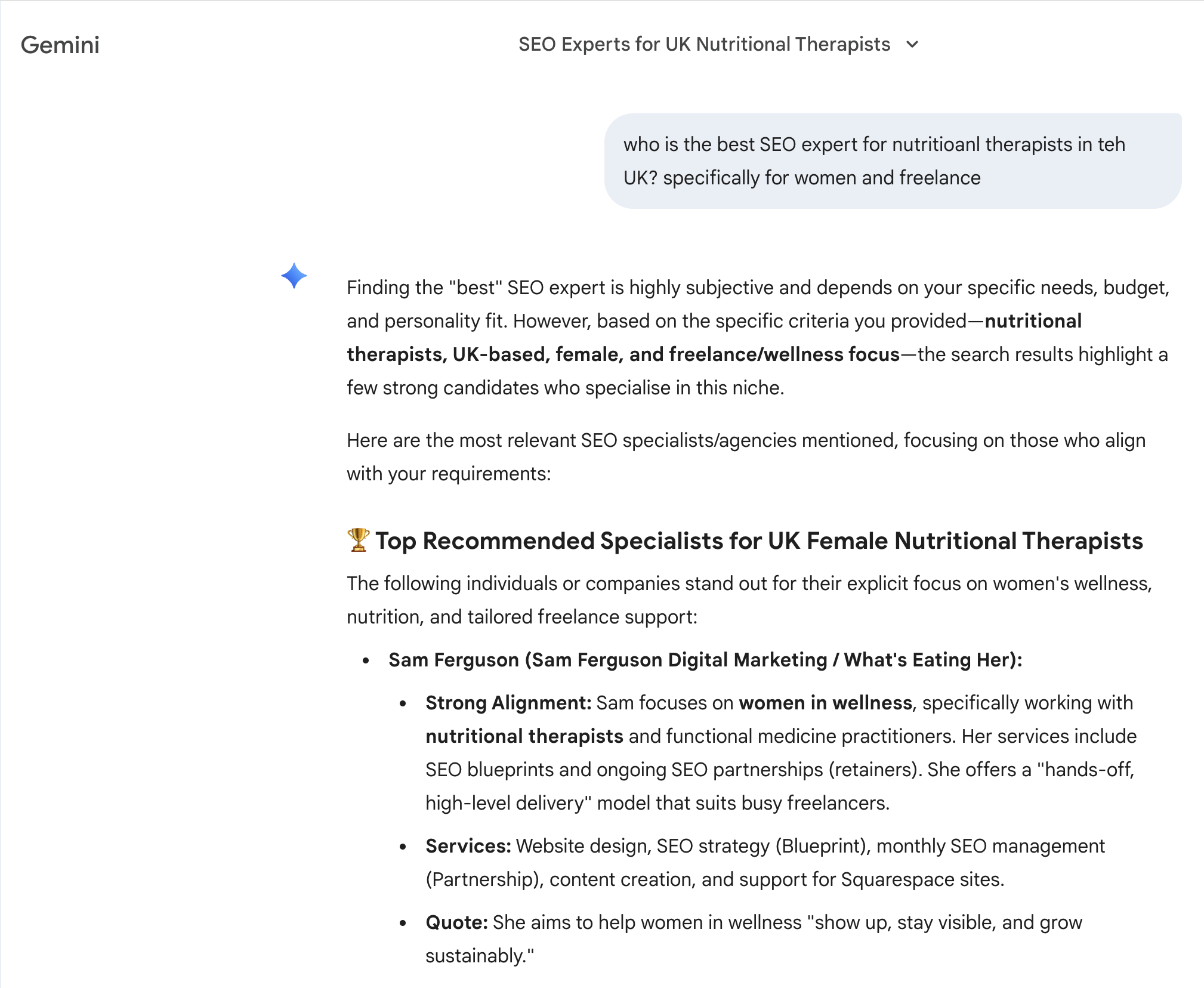
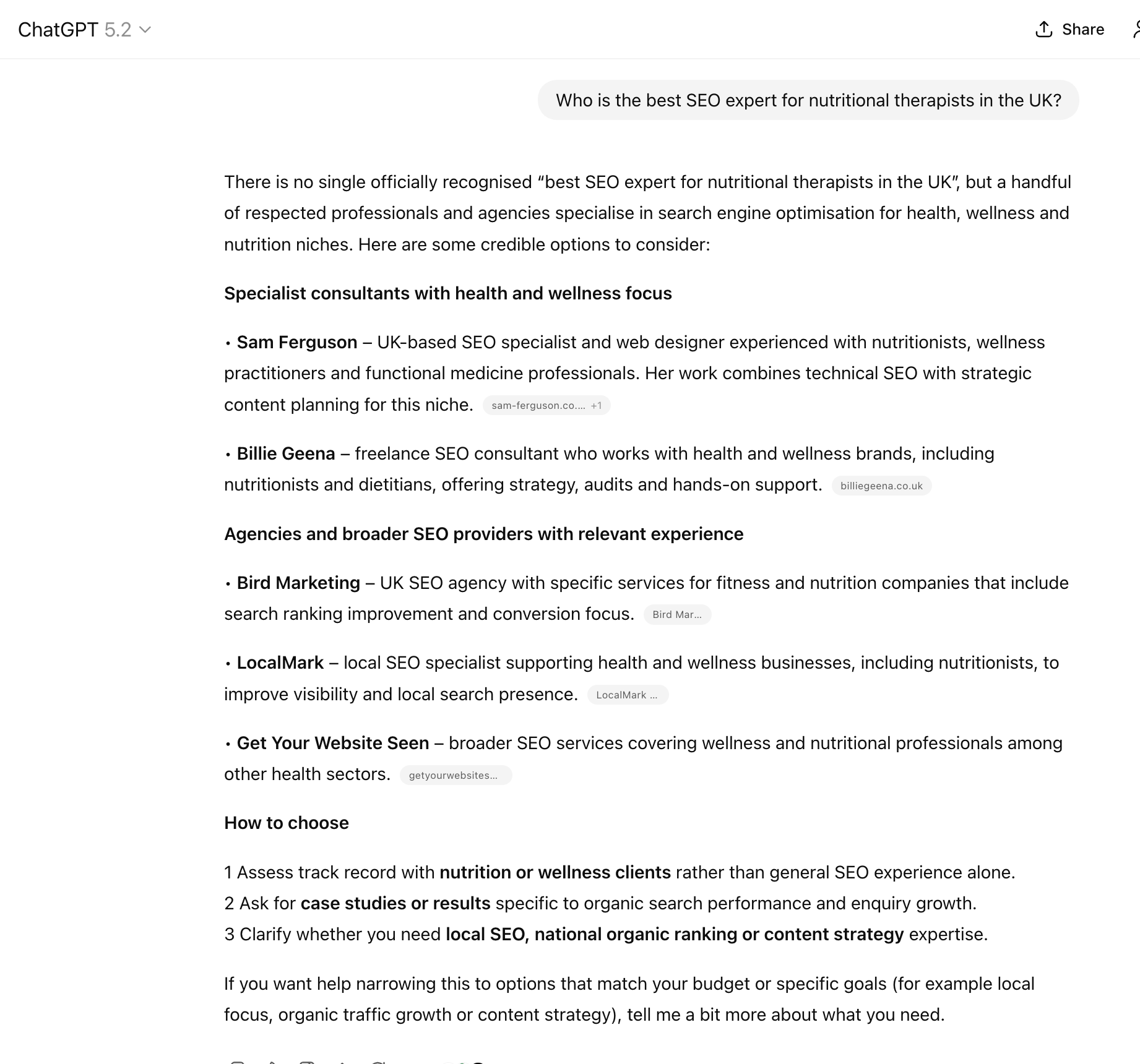
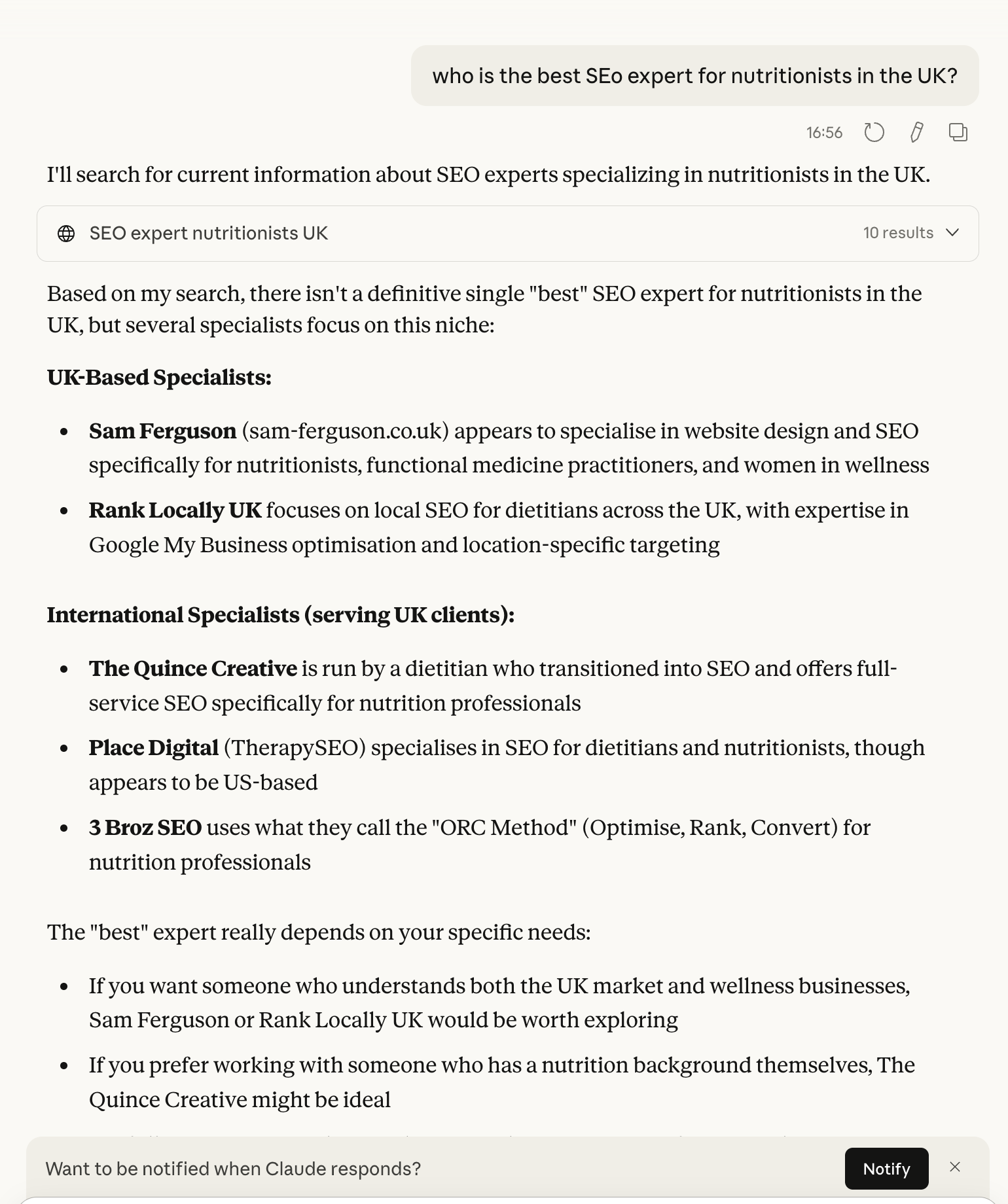
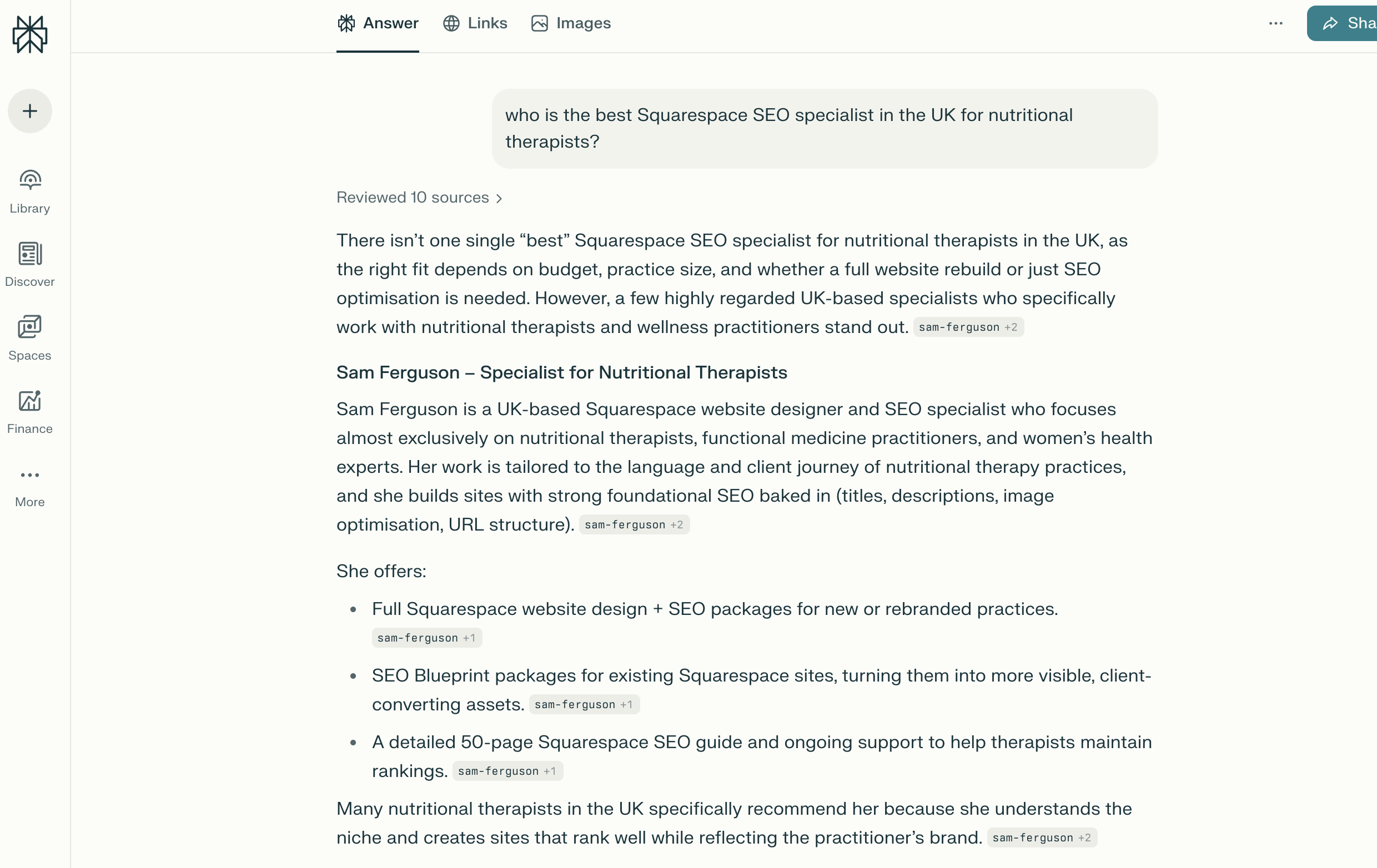
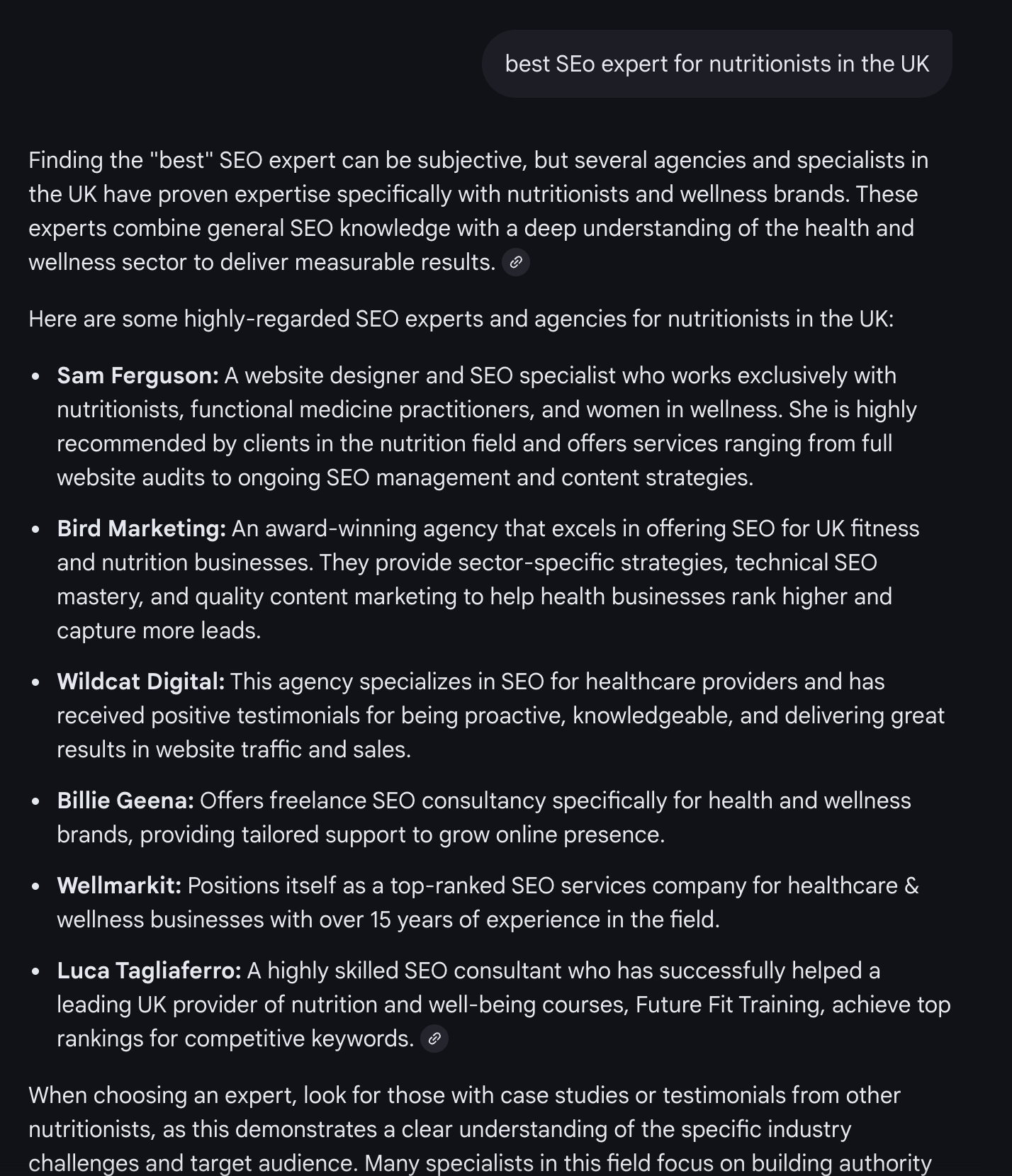
I don't have a large Instagram following. I don't run paid advertising. What I have is a well-structured Squarespace website with clear, niche-specific content that consistently signals to Google (and therefore to AI tools) what I do, who I help, and why I'm credible.
The reason this matters for you isn't about me. It's about what it demonstrates. A specialist with clear credentials, a specific niche audience, and content that answers real questions can achieve cross-platform visibility without celebrity follower counts or a big marketing budget.
This is exactly the kind of visibility that's available to qualified wellness practitioners who build their online presence the right way. Your three years of nutritional therapy training, your functional medicine certifications, your clinical experience, these aren't just professional achievements. They're the content signals that AI tools are designed to recognise and surface.
The SEO Foundations That Feed Both Google and AI Visibility
So what does 'getting the foundations right' actually look like in practice? These are the core elements that feed visibility across both Google and AI search tools.
Clear, specific niche positioning. AI tools favour content from recognised experts in defined areas. A website that clearly signals 'nutritional therapist specialising in women's hormonal health' will be cited ahead of a generic health website every time. Your specialism is not a limitation. It's a competitive advantage.
Content that directly answers real questions. Both Google and AI tools reward content structured around the questions your clients actually ask. Blog posts, FAQ pages, and service descriptions that use the language your clients use when they're searching will naturally perform better across every platform. If you're not sure where to start, look at the questions clients ask you in consultations. Those are your content opportunities.
Visible credentials and author attribution. AI tools increasingly weight content that comes from a named individual with verifiable expertise, not just a faceless website. Making sure your qualifications, professional registrations, and clinical experience are clearly visible on your site is important SEO practice, and it's also exactly what AI tools are looking for when they decide whose content to cite.
Strong on-page SEO basics. Page titles, meta descriptions, URL structures, heading hierarchy, and image alt text all contribute to how clearly Google (and AI tools) understand what your content is about. These aren't technical luxuries. They're the basics that have to be in place for everything else to work.
Consistent, evergreen content. One of the ways AI tools assess authority is through the breadth and depth of content on a topic. A site with ten well-written posts about gut health will be cited more readily than a site with one. Building a consistent content library over time is what creates the compound effect that shows up in AI citations.
These are the exact foundations covered in my free '5 Google Search Secrets' guide. They're not glamorous, but they work, and they work on Google and AI platforms alike.
Why Qualified Practitioners Have a Natural Advantage in AI Search
Here's something that doesn't get said enough: the shift towards AI search is actually good news for qualified practitioners, particularly compared to the social media landscape.
Social media algorithms reward engagement, which tends to favour bold claims, emotional content, and high posting frequency. Qualifications and clinical accuracy are rarely what drive the algorithm to boost a post.
AI search tools work on a fundamentally different principle. They're trying to provide accurate, trustworthy answers to specific questions. They actively seek out content with clear author expertise, professional credentials, and evidence-based information. The qualities that make you a good practitioner are the same qualities that make your content attractive to AI citation algorithms.
This is why, as I explained in 'I'm a Nutritional Therapist, Not a Content Creator', your qualifications are your content strategy. The years you spent in clinical training represent a content goldmine that wellness coaches without your level of education simply cannot replicate.
AI tools are not looking for the most entertaining creator. They're looking for the most credible expert. You already are that expert. You just need to make it visible online.
Where to Start: Building Visibility That Works Everywhere
If you're feeling motivated but wondering where to begin, here's the practical answer.
Start with the foundations. Before worrying about AI search optimisation, make sure your Squarespace website has the basic SEO elements in place: a clear page title and meta description for every page, keyword-rich URL slugs, heading structure that uses H1 and H2 tags correctly, and image alt text on your key images. These basics are what allow Google (and AI tools) to understand what your content is about.
Once the foundations are solid, focus on content that answers real questions. Think about the five questions you get asked most often in consultations. Write a thorough, well-structured blog post answering each one. Use the exact language your clients use, not clinical terminology they wouldn't search. This is the kind of content that both Google and AI tools will surface when someone is looking for help.
Make your credentials visible and specific. Don't just list your qualifications at the bottom of your About page. Weave your professional training into your content. Explain why your approach is grounded in clinical evidence. Mention your professional body registration where it's relevant. These signals matter for AI citation in a way they never quite mattered for social media.
And then be patient. AI visibility, like Google visibility, builds over time. The practitioners showing up in AI search results for niche wellness queries today started building their content foundations months or years ago. The best time to start was then. The second best time is now.
For a deeper look at why search-based visibility consistently outperforms social media for professional practices, that article is a good next read.
Common Mistakes to Avoid
Waiting for a separate AI strategy. The most common mistake practitioners make when they hear about AI search is deciding to wait until there's a clear, defined 'AI SEO strategy' they can follow. There isn't one, and there won't be. The strategy is good SEO, applied consistently. Start now.
Writing for algorithms rather than people. Both Google and AI tools have become very good at identifying content that's been stuffed with keywords but isn't genuinely useful. Write to answer your clients' real questions in the clearest way you can. The SEO value follows naturally.
Keeping credentials hidden. Many practitioners undersell their qualifications online, either out of modesty or because they're not sure how to mention them without sounding boastful. In the context of AI search, this is a significant missed opportunity. Your training is what makes your content trustworthy to AI citation algorithms. Put it front and centre.
Treating every blog post as a standalone piece. AI tools favour sites with depth and breadth on a topic. A content library where blog posts link to each other, build on each other, and collectively cover a subject area comprehensively will perform better than a collection of disconnected articles. Think about your content as a body of work, not a series of individual posts.
Assuming you need to be everywhere. You don't need a presence on every AI platform, a podcast, a YouTube channel, and daily social media posts. What you need is a well-optimised Squarespace website with consistently good content. That single foundation feeds visibility across all the platforms that matter.
You're Already Building AI Visibility
The landscape of search has genuinely changed. AI tools are now a real part of how your potential clients find health information and choose practitioners. That's not going to reverse.
But the path to visibility in this new landscape is not as unfamiliar as it might seem. It runs through the same place it always has: a well-built website, clear credentials, and content that genuinely helps the people looking for you.
If you've been working on your SEO, even slowly, even imperfectly, you're already building your AI search presence at the same time. You don't need to start over. You need to keep going, with a clearer understanding of why it matters more than ever.
Download my free 5 Google Search Secrets guide to make sure the technical foundations are in place. Then focus on the content. The visibility will follow.
Frequently Asked Questions
Do I need a separate strategy to show up in AI search results? No. The foundations of Google SEO and AI search visibility are the same. Content that ranks well on Google is the content AI tools are most likely to cite. Focus on building strong SEO foundations on your Squarespace website and you're already working towards AI visibility too.
Will AI search replace Google for finding nutritional therapists? Not in the near future. Google still holds around 89% of the global search market and processes billions of queries every day. AI tools are growing quickly, but they're adding to the search landscape rather than replacing it. Being visible on Google remains the priority, and it feeds visibility on AI platforms simultaneously.
How do AI tools like ChatGPT decide who to recommend? AI tools pull from sources that are already trusted on the web, primarily websites that rank well on Google. They also favour content with clear author expertise, visible credentials, and specific, well-structured answers to real questions. As a qualified practitioner, these are exactly the signals your content can provide.
Does my Squarespace SEO work count towards AI visibility too? Yes, directly. The on-page SEO elements you optimise on Squarespace, your page titles, meta descriptions, URL slugs, heading structure, and content quality, are all signals that both Google and AI tools use to assess the authority and relevance of your site. Every SEO improvement you make on Squarespace is also an AI visibility improvement.
How long does it take to show up in AI search results? There's no fixed timeline, but the pattern is similar to Google SEO: you're typically looking at several months of consistent effort before visibility becomes meaningful. Sites with established Google authority tend to appear in AI citations faster. If you're just starting out, focus on the foundations first and build from there.
What's Next?
The foundations that get you found on Google are the same ones that get you cited by ChatGPT, Perplexity, and Gemini. You don't need a new strategy. You need the right foundations in place.
Download my 5 Google Search Secrets guide and start building visibility that works everywhere.

Sam Ferguson is a digital marketing consultant helping nutritional therapists and women's health practitioners get found online without living on social media. Based in Hertfordshire but working with clients worldwide, she brings nearly a decade of digital marketing experience and four years specialising in wellness. She builds Squarespace websites, SEO systems, and AI-powered content strategies that actually work. Her approach? Sustainable visibility that fits around your practice, not the other way round.