
Why Instagram's Growth Tips Don't Fit Your Practice
Adam Mosseri, Instagram's head, regularly shares advice for growing on the platform: post more Reels, create original audio, engage in DMs within an hour, show your personality, and be consistent.
If you're a qualified nutritional therapist or wellness practitioner, you've probably seen this advice everywhere. You've likely tried to follow it.
And if you're honest, it's probably left you feeling exhausted, inadequate, or both.
Here's what nobody's telling you: Mosseri's advice works brilliantly for the people it was designed for. The problem is, you're not one of them. Instagram was built for creators, influencers, and entertainers whose entire business model revolves around building large audiences. Your business model is fundamentally different. You're a professional service provider with qualifications, regulatory accountability, and a practice built on clinical expertise, not follower counts.
This isn't about whether Instagram is 'good' or 'bad'. It's about understanding why advice designed for the creator economy doesn't translate to professional service businesses, and why you shouldn't feel guilty for struggling with strategies that were never meant for you in the first place.

Before diving deeper, if you're ready to explore marketing foundations that actually align with professional practice models, grab my free 5 Google Search Secrets guide. These are the technical essentials that qualified practitioners need in place before anything else will work sustainably.
What Adam Mosseri Actually Said (and Who He's Really Talking To)
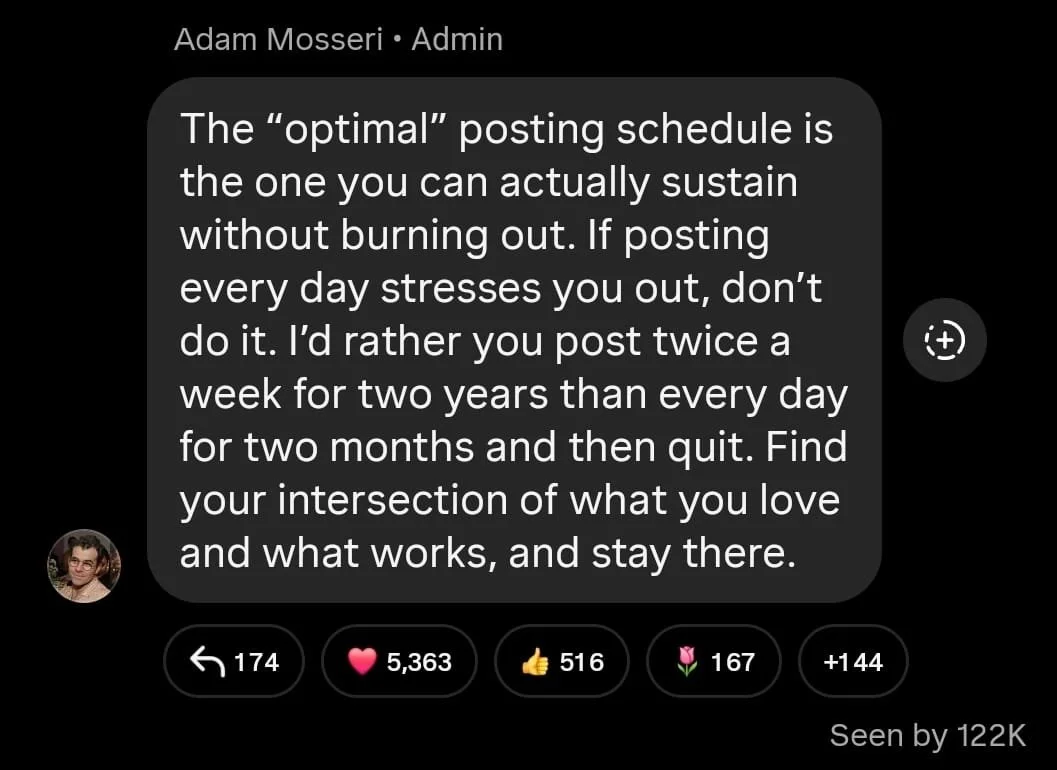
Let's start with what Instagram's head actually recommends for growth on the platform. The screenshot above is a good example of the kind of advice Mosseri regularly shares publicly.
And in various posts and interviews, he consistently advises:
Post 2-3 Reels per week to maximise reach
Create original audio rather than using trending sounds
Respond to DMs within the first hour for better engagement signals
Show your personality and what makes you unique
Be consistent with your posting schedule
Use features like Stories, Carousels, and interactive stickers
Focus on building community through authentic connection
On the surface, this sounds reasonable. It's practical, actionable advice. The problem isn't that the advice is wrong. The problem is understanding who it's designed for.
When Mosseri talks about 'creators', he's specifically referring to people whose primary business model is building and monetising an audience. These are influencers, content creators, entertainers, and lifestyle personalities who earn through brand partnerships, affiliate marketing, sponsored content, and advertising revenue. For them, audience size directly correlates to income potential. A creator with 500,000 followers can command significantly higher sponsorship fees than one with 50,000.
For these creators, Mosseri's advice makes perfect sense. Their job is creating content. Posting multiple Reels per week, responding instantly to DMs, and 'showing personality' are core business activities, not additions to an already full schedule.
But you're not a creator. You're a qualified practitioner running a professional service business. Your income comes from consultations, not collaborations. Your professional standing depends on clinical expertise, not engagement rates. And your time is already occupied with client work, CPD requirements, admin, and all the other demands of running a practice.
When qualified practitioners try to implement creator-focused advice, the mismatch becomes painfully obvious.
The Problem: Instagram Is Built for Creators, Not Practitioners
Instagram's entire platform architecture is optimised for a specific type of content and business model. Understanding this design intent is crucial for recognising why you keep hitting walls.
Instagram is fundamentally an entertainment platform. It was built to keep users scrolling, laughing, discovering, and escaping. The algorithm rewards content that generates immediate emotional reactions, shares, and extended viewing time. It doesn't measure professional qualifications. It doesn't assess clinical accuracy. It doesn't distinguish between evidence-based health advice and feel-good wellness content.
Research consistently shows that Instagram rewards content that conflicts with professional standards. Studies of health influencer content found that 87% of posts mention benefits of interventions, but only 15% mention potential harms, and just 6% reference actual scientific evidence. That's not evidence-based practice. That's content optimised for engagement.
The platform's reward system creates a fundamental conflict for qualified practitioners. The content that performs best algorithmically is often precisely the content you cannot and would not ethically create:
Oversimplified health messaging gets more shares than nuanced clinical explanations. 'Five foods that heal your gut' will always outperform 'The complex relationship between gut microbiome diversity and inflammatory markers in digestive disorders'.
Controversial takes generate engagement. Telling people that mainstream medical advice is wrong (regardless of evidence) sparks comments, shares, and algorithmic favour.
Personality-driven content builds followings faster than expertise-driven content. People connect with relatable humans, not qualified professionals maintaining appropriate boundaries.
Aspirational lifestyle content performs better than realistic health journeys. The 'before and after' transformations, the perfect morning routines, the aesthetically pleasing supplement collections.
None of this is inherently problematic for creators whose business model depends on audience growth. But for qualified practitioners bound by professional codes of conduct, regulatory accountability, and ethical obligations, the platform's reward system directly conflicts with professional standards.
When Mosseri advises you to 'show your personality' and 'create content that stops the scroll', he's speaking a language designed for people who aren't constrained by professional boundaries. You are. And that's not a failure on your part. That's a fundamental platform mismatch.
Why Users Scroll Instagram (Hint: It's Not to Book a Nutritionist)
Here's the uncomfortable truth about Instagram: people don't open the app looking for professional health support. They open it for entertainment, inspiration, distraction, and escapism.
Understanding user intent on Instagram versus search platforms is crucial for recognising why creator strategies don't translate to professional service acquisition.
When someone opens Instagram, they're typically:
Taking a break from work or responsibilities
Looking for entertaining or inspiring content
Seeking social connection or community
Wanting distraction or escapism
Scrolling mindlessly during downtime
When someone searches Google for 'nutritionist for PCOS London' or 'functional medicine practitioner fertility support', they're in a completely different mindset. They're actively seeking professional help. They're in research mode. They're comparing qualifications, reading credentials, and looking for evidence of expertise.
These are fundamentally different contexts requiring completely different marketing approaches.
On Instagram, even if someone follows you because they're interested in health content, they're not necessarily in 'I need professional help' mode when they see your posts. They're in consumption mode, entertainment mode, scrolling mode. Converting that casual interest into a paid consultation requires significant additional steps that the platform isn't designed to facilitate.
Compare this to someone who finds your website through Google search. They've actively typed in a specific query related to their health concern. They're looking for qualified help. They're already several steps further along the decision-making journey. When they land on your professionally structured website with clear credentials, detailed service information, and evidence of expertise, the conversion path is much shorter and more natural.
This doesn't mean Instagram has no value. It can be brilliant for staying connected with existing clients, building referral relationships with other practitioners, or sharing quick updates with people who already know you. But as a primary client acquisition channel for professional services, the platform's fundamental user intent creates significant friction.
When Mosseri advises posting more Reels to 'reach new audiences', he's optimising for discovery within an entertainment context. That's valuable for creators whose business model is audience growth. But for practitioners who need qualified leads ready to book consultations, reach without intent isn't particularly useful. You don't need 10,000 people casually interested in gut health content. You need 10 people actively seeking qualified support for their specific digestive concerns.
The Creator Economy vs Professional Service Economy: Why the Rules Are Different
To understand why Instagram's advice doesn't translate, you need to understand the fundamental business model difference between creators and professional service providers.
Creators monetise through audience size. Their income comes from brand partnerships, sponsored content, affiliate marketing, and advertising revenue. A wellness creator with 200,000 followers can earn substantial income from brand deals alone, even without formal qualifications. For them, follower count, engagement rate, and reach are genuine business metrics. Consistency, personality, and entertainment value are actual business assets.
Practitioners monetise through professional expertise. Whether you work one-to-one through consultations or one-to-many through group programmes, your income is tied to your qualifications and specialist knowledge. A nutritional therapist with 200 followers but strong search visibility and professional credibility can run a fully booked practice. For you, qualified enquiry rates, programme enrollments or consultation bookings, and client outcomes are the business metrics that matter. Qualifications, clinical experience, and evidence-based practice are your actual business assets.
These models require completely different growth strategies.
When Instagram's advice tells you to 'be consistent and post regularly', it's speaking to people whose job is content creation. For a creator, spending 10-15 hours per week on content production is a core business activity directly tied to income.
For you, spending 10-15 hours per week on Instagram is time away from client work, professional development, or actually running your practice. Unless that time demonstrably converts to qualified enquiries or programme sign-ups at a rate that justifies the opportunity cost, it's not a sustainable business strategy.
This is why you can feel like you're 'failing' at Instagram while simultaneously running a successful practice. You're measuring yourself against creator economy metrics (followers, engagement, reach) when your actual business success depends on completely different factors (qualified enquiries, client outcomes, professional reputation).
The Real Issue: You're a Service Business on an Entertainment Platform
Here's what's actually happening: you're trying to market a professional service business on a platform designed for entertainment and escapism.
This isn't about whether you're posting enough Reels or responding to DMs fast enough. It's about a fundamental mismatch between what Instagram rewards and what your business actually needs.
Instagram's algorithm is designed to keep people scrolling, not to connect them with qualified professional support. The platform prioritises content that generates immediate emotional reactions, keeps users engaged for extended periods, and encourages them to stay within the app rather than clicking away to book consultations.
Your business model requires something completely different. You need people who are actively seeking qualified help, ready to invest in professional support, and looking to move from research mode to booking mode relatively quickly.
When someone is scrolling Instagram, they're rarely in that mindset. They're taking a break, seeking distraction, or consuming entertaining content. Even if they follow you because they're interested in health topics, there's a significant gap between 'casually interested in gut health content' and 'ready to book a consultation with a qualified nutritional therapist'.
This gap exists regardless of how good your content is, how consistent you are, or how well you follow Instagram's official advice. The platform simply wasn't built to bridge that particular gap efficiently.
The constant advice to 'show up more', 'be more consistent', and 'engage more' assumes the problem is your execution. But for most practitioners, the problem isn't execution. It's that you're investing significant time and energy into a channel that fundamentally doesn't align with how your ideal clients actually seek and select professional health support.
You're Not Failing at Instagram - Instagram Is Failing Your Business Model
If you've been feeling inadequate because you can't maintain the Instagram presence marketing advice demands, it's time to reframe that narrative.
You haven't failed at Instagram. Instagram has failed to accommodate professional service business models that don't fit the creator economy framework.
The platform's architecture, algorithmic priorities, and official growth advice are all designed around a business model that isn't yours. Expecting yourself to succeed on those terms is like expecting a clinical research paper to go viral on TikTok. The format and the content type are fundamentally mismatched.
This misalignment creates several specific problems for qualified practitioners:
Time investment doesn't match business return. The hours required to execute creator-focused strategies rarely convert to enough qualified enquiries to justify the opportunity cost. Those same hours spent on SEO-based visibility that aligns with professional service businesses typically generate more sustainable results.
Professional boundaries conflict with platform expectations. Instagram rewards personal vulnerability, constant availability, and blurred lines between personal and professional. Qualified practitioners appropriately maintain professional boundaries, which the algorithm interprets as low engagement or inauthentic presence.
Content that builds professional authority often performs poorly algorithmically. Detailed, nuanced, evidence-based health information doesn't generate the immediate emotional reactions that drive engagement. Oversimplified, dramatic, or controversial content does. You can't win that game without compromising professional standards.
The pressure to constantly create content conflicts with actually running a practice. Creators are content businesses. Practitioners are service businesses. These require different time allocations, different skill sets, and different priorities.
Platform volatility creates business instability. Algorithm changes, feature updates, and shifting platform priorities can dramatically impact reach overnight. Building your practice's visibility primarily on someone else's platform means accepting vulnerability to changes completely outside your control.
None of this means Instagram is inherently bad or that no practitioner should use it. Some qualified professionals genuinely enjoy the platform and use it effectively as part of a broader marketing mix. But it does mean that if Instagram feels like a constant uphill battle, if you dread creating content, if you feel inadequate every time you see Mosseri's latest advice, you're not failing. You're experiencing the natural friction that arises when a business model designed for professional services is forced to operate on a platform built for the creator economy.
The solution isn't trying harder to become a creator. The solution is recognising that your professional expertise deserves marketing approaches built for professional service businesses, not entertainment platforms.
What Actually Works: Marketing Built for Professional Practices
If Instagram's creator-focused approach doesn't fit your business model, what does? Marketing strategies designed specifically for professional service businesses that depend on qualified leads rather than large audiences.
The fundamental principle is this: make your professional expertise searchable rather than trying to make it entertaining.
Search-based visibility puts you in front of people actively seeking professional help. When someone searches 'nutritional therapist PCOS Hertfordshire' or 'functional medicine practitioner thyroid UK', they're not scrolling for entertainment. They're in research mode, comparing options, and ready to book qualified support. Your professional credentials, detailed service information, and evidence-based content are exactly what they're looking for.
Authority content builds professional reputation over time. One comprehensive blog post explaining the clinical approach to addressing hormonal imbalances in perimenopause can rank in Google for years, bringing consistent qualified enquiries. It positions you as someone who understands complex mechanisms, not just someone sharing quick tips. This type of content leverages your actual training rather than requiring you to develop separate content creation skills.
Professional qualifications become competitive advantages rather than constraints. In search-based marketing, your years of training, professional registration, clinical experience, and evidence-based approach are exactly what distinguishes you from unqualified wellness coaches. You're not competing on personality or entertainment value. You're competing on professional credibility, which you already have.
Time investment scales differently. Creating one well-researched, strategically optimised piece of content per month is sustainable alongside running a full practice. That content continues working for you indefinitely. Three Reels per week that disappear from feeds within 48 hours require constant production for temporary visibility.
Business stability doesn't depend on platform volatility. Your website, your domain, your content, and your search visibility are assets you control. Algorithm changes at social platforms don't eliminate years of work overnight.
This approach takes longer than viral Instagram growth. But viral growth isn't a strategy most practitioners ever achieve anyway. It's a lottery most service businesses never win. Strategic visibility built on professional expertise is predictable, sustainable, and aligned with how your ideal clients actually search for help.
If you're ready to start building visibility that works with your professional model rather than against it, begin with the foundations. Download my 5 Google Search Secrets guide to understand the technical essentials that must be in place before strategic content will work effectively.
You Don't Need to Be a Creator to Run a Successful Practice
The pressure to build a personal brand, show up daily, and create endless content comes from a marketing landscape designed for a different business model. Wellness creators need large audiences because their income depends on volume, reach, and influence. They need constant visibility because they're competing with thousands of other personalities for brand partnership opportunities.
You have a fundamentally different competitive advantage. You have qualifications that took years to earn. You have clinical training that wellness coaches don't possess. You have regulatory accountability that establishes professional trust. You have the ability to provide genuinely personalised, expert guidance for complex health concerns.
Those advantages don't require 50,000 Instagram followers to be valuable. They require visibility among the specific people actively seeking qualified professional support for the exact concerns you're trained to address.
When Mosseri publishes his latest advice about how to grow on Instagram, he's speaking to creators whose entire business model is audience growth. That's not your business model. You became a qualified practitioner to make a meaningful difference in people's health through expert clinical support, not to become an influencer.
If your goal is Instagram fame, then yes, you'll need to follow creator economy rules. But if you became a qualified practitioner to build a sustainable professional practice, your time and expertise are worth more than chasing algorithmic favour on an entertainment platform.
Stop trying to become a creator. Start making your professional expertise searchable. That's a marketing strategy you already have the knowledge to execute. You just need to make it visible in the places where your ideal clients are actively looking for qualified help.
Frequently Asked Questions
Q: Does Instagram work for wellness businesses?
A: Instagram can work for certain wellness business models, particularly those built on community, lifestyle content, or products. For qualified practitioners offering professional services, it's less effective as a primary client acquisition channel because the platform's entertainment focus doesn't align with how people seek qualified health support. It can be useful for staying connected with existing clients or building referral relationships, but rarely generates the volume of qualified enquiries that justifies the time investment required to execute creator-focused strategies.
Q: How do nutritionists get clients on Instagram?
A: Nutritionists who successfully acquire clients through Instagram typically do so through one of two pathways: building large audiences over years (10,000+ followers) where sheer volume eventually converts some followers to clients, or using Instagram primarily for networking with other professionals who then make referrals. Both approaches require significant time investment and work better for those who genuinely enjoy the platform. Most qualified practitioners find that search-based visibility generates more qualified enquiries with less ongoing effort.
Q: Why is my Instagram not getting clients?
A: Instagram's algorithm prioritises entertainment and engagement over professional credibility. Even if you gain followers, most aren't in 'ready to book professional help' mode when scrolling the platform. They're in consumption or entertainment mode. Converting casual content consumption into consultation bookings requires significant additional steps. If you're looking for qualified client enquiries rather than just followers, search-based marketing typically performs better because people using search are actively seeking professional support, not scrolling for entertainment.
Q: What is the best social media platform for nutritionists?
A: The 'best' platform depends entirely on your goals and what you enjoy. Instagram works for community building and referral relationships. LinkedIn can be valuable for B2B connections if you work with corporate wellness. However, for most qualified practitioners focused on direct client acquisition, search-based visibility through Google often outperforms social platforms because it reaches people actively seeking qualified help rather than casually consuming content. Rather than asking which social platform is best, consider whether social platforms are the right primary marketing channel for your business model.
Q: How often should health practitioners post on Instagram?
A: Instagram's algorithm favours frequent posting (2-3+ times per week), but this recommendation is designed for creators whose business model is audience growth. For qualified practitioners, the question isn't 'how often should I post' but 'does the time investment in frequent posting generate enough qualified enquiries to justify the opportunity cost?' For most practitioners, the answer is no. Time spent creating strategic, searchable content on your website typically generates better business results than time spent maintaining consistent Instagram presence.
What's Next?
If you're ready to stop following advice designed for creators and start building visibility suited to professional practice, begin with the foundations.
Download my 5 Google Search Secrets guide to understand the essential technical basics that must be in place before strategic content marketing will work effectively. These are the simple but crucial fundamentals that most SEO agencies won't share for free, and they're the starting point for making your professional expertise searchable.

Sam Ferguson is a digital marketing consultant helping nutritional therapists and women's health practitioners get found online without living on social media. Based in Hertfordshire but working with clients worldwide, she brings nearly a decade of digital marketing experience and four years specialising in wellness. She builds Squarespace websites, SEO systems, and AI-powered content strategies that actually work. Her approach? Sustainable visibility that fits around your practice, not the other way round.